
Indian benchmark indices, Sensex and Nifty, extended their losses for a second consecutive day, primarily due to HDFC Bank's disappointing quarterly earnings and escalating tensions in West Asia, coupled with persistent foreign fund outflows.
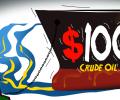
A prolonged supply shock can transmit to lower incomes, and dampen confidence and sentiment, warns Aditi Nayar, chief economist, head-research and outreach, ICRA.

The Indian government is considering additional relief packages for vulnerable sectors like MSMEs to mitigate the impact of the ongoing West Asia crisis on the economy and inflation.

Foreign investors pulled out Rs 21,000 crore (around $2.3 billion) from Indian equities over the last four trading sessions amid deteriorating global risk sentiment triggered by the West Asia crisis.

Nayara Energy, India's largest private fuel retailer, has reduced petrol prices by Rs 5 per litre and diesel by Rs 3 per litre nationwide, marking the first such cut in over two years. This reduction follows easing tensions in West Asia and stabilised international crude oil prices, though public sector retailers have not yet followed suit.

China sailed through the crisis in the Strait of Hormuz relatively unscathed even as the impact of its steps shielded other consuming nations from having to pay high crude oil prices.

The Confederation of Indian Industry (CII) has urged the Indian government to gradually restore the Rs 10-per-litre cut in special additional excise duty on petrol and diesel over six to nine months. This move aims to relieve pressure on government finances as crude oil prices stabilise, without significantly impacting consumer sentiment.

Prime Minister Narendra Modi cautioned against the 'weaponisation' of technology and critical minerals at the BRICS summit, advocating for cooperation to foster shared prosperity. Concurrently, Chinese President Xi Jinping announced plans for an open-source AI ecosystem for BRICS nations, positioning Beijing as a key technology partner amid global AI competition.

The Reserve Bank of India (RBI) and the central government have introduced a package of measures, including tax exemptions for FPIs on government securities and a concessional foreign-exchange swap facility, aiming to attract up to $50 billion in foreign capital. This initiative is designed to strengthen India's balance of payments and potentially cover the projected BoP gap for FY27.

India on Friday launched a highly coordinated, priority operation to safely guide 13 Indian-flagged commercial vessels out of the volatile Strait of Hormuz, the ministry of ports, shipping, and waterways announced on Friday.

Amidst a sharp run-up in gold and silver prices, investors are advised to rebalance their portfolios by booking partial profits in precious metals and reallocating to domestic equities and debt, according to financial experts.

India's plans to ration the consumption of liquefied natural gas (LNG) and liquefied petroleum gas (LPG) - in response to reduction in their import owing to war in West Asia - may fall short of what is needed to meet domestic needs.
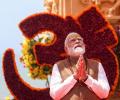
'At the first sign of real trouble, that money will move. There will be a run.'
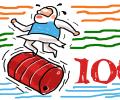
'Once the currency goes out of the hand, then possibly your major challenge is that it will not come back.'

'We are profoundly energy-dependent on the Gulf. That dependency must now be redirected towards the United States, because we require American permission to procure oil.' 'We additionally require Iranian permission to acquire oil from that source. So India now has to seek two separate permissions merely to secure its energy supply.' 'Should we be compelled to source from America, or from Venezuela -- which is, in effect, American-controlled supply -- that will inevitably carry a price premium, an elevated shipping cost, and a considerably extended delivery timeline, given the distances involved.'

'If movement remains stalled for three to four months, more than 300,000 recruitments from India could be affected.'

The International Chess Federation (FIDE) has sought to allay security concerns surrounding the upcoming Candidates Tournament in Cyprus, emphasising that safety measures and contingency plans are in place despite regional instability.

Karex, the Malaysian company that makes roughly one in five of the world's condoms -- about five billion a year, supplying Durex and Trojan among others -- announced this week that it is raising prices by up to 30 percent. The reason is the Strait of Hormuz.

'There is no shortage of fuel whatsoever.' 'India is stock surplus as far as petrol and diesel are concerned.'

This weekend, Donald Trump has begun to say the quiet part out loud -- that he wants to take control of Iran's oil, a formulation more in line with his robber-baron style of international relations.
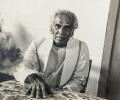
What appeared to be a generous act of friendship was, in truth, a manoeuvre within a much larger strategic game. The United States used the 1962 war not just to aid India but to test how far it could be pulled into the Western fold, points out Dr Kumar.

The textile and apparel sector is India's second-largest employment provider, after agriculture, and it is now caught in a wave of uncertainty following the Donald Trump administration's tariff policy.
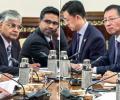
'These efforts by Beijing can be weaponised one day with economic, security and political implications for India.'
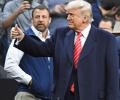
Trump is confident the US will eventually emerge the winner from whatever turmoil his policies cause, notes T T Ram Mohan.
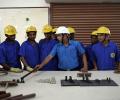
Severe skilled, unskilled shortage threatens to pull emergency brakes on India's industrial engine.
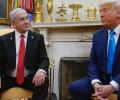
'Netanyahu lured Trump into a trap by enticing him with a seductive scenario of massive lucrative business in Gaza's reconstruction.' 'Trump's imagination is running riot, completely disconnected from ground realities,' asserts Ambassador M K Bhadrakumar.

All eyes will be on star India batter Virat Kohli, who is perhaps battling the biggest form crisis of his career.

'The pay cuts have been very tough on those with entire families to support.'

Meanwhile, investors pulled out a record $14.45 billion out of bond funds tracked by EPFR Global, as fears that US monetary policy will tighten in the second half of the year prompted more investors to head for the exits.

Can Modi and Obama forge a common outlook on international terrorism?

Reduce frill expenses, monetise your assets and invest in professional development to negotiate the choppy phase.
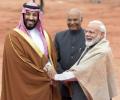
'The more emphatic denial of any proposal for an OIC foreign ministers meet in Islamabad appears aimed at keeping Pakistan on a leash,' notes Lieutenant General Syed Ata Hasnain (retd).

Only a leader with sufficient moral authority with voters can pull off such experiments, notes T N Ninan.

'China's economy continues to slow and the US Fed may still hike rates before the end of the year.'

Protectionism and a rollback of regulation. Defusion of tensions with Russia and a lowering of geo-political risks. Looser fiscal policy and tighter monetary policy. At least Donald Trump can't be faulted for not trying something different where existing policies have disappointed, says T T Ram Mohan.

The game plan is to pressure India and China to come back and commit to further emissions cuts by next year's UN meeting. Neither China nor India has 2030 targets anywhere near in line with a 1.5 degree centigrade pathway, and so will be on the target list of nations under pressure to return next year with more ambition, predicts Ambassador M K Bhadrakumar.

The developments in Af-Pak region, particularly the fall out of Pak political paralysis, would make President Xi Jinping's task a little more complicated, says Colonel R Hariharan.

Besides their country of origin, General Motors, Ford Motor and Harley-Davidson have another trait in common: all three have failed in India, the world's fifth largest automobile market. All three of them took a tough call to de-prioritise India as a market amid disruption from heightened regulations and sharper focus on capital allocation by the parent.

If Aylan Kurdi was a Bangladeshi boy on the border with Assam or West Bengal, would you call him an infiltrator, asks Mango Indian.
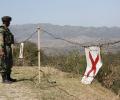
'The response to terror is not always reciprocal terror, nor is launching a conventional response the best response.' 'The best response is to make the sponsor pay a price he cannot afford,' says former RA&W chief Vikram Sood.
